Same-day appointments · Kyle, TX 78640
Tankless water heater repair in Kyle, TX
Cold showers, an error code flashing, a unit that clicks but never lights: one call connects you with a licensed Kyle plumber who works on Rinnai, Navien, Noritz and Rheem tankless heaters every week.
- Licensed & insured providers
- Same-day when available
- All major gas & electric brands
Kyle Tankless Pros is a free referral service. Calls are connected to an independent, licensed local plumbing company that diagnoses, quotes and performs the repair.

Start here
Your tankless heater stopped. Here's what actually happens next.
Short answer: most tankless failures in Kyle are repairable the same day. The unit is a small gas or electric appliance with a handful of replaceable parts: sensors, an igniter, a flame rod, a control board, a gas valve, a vent and a heat exchanger. When one of them fails, the unit shuts itself down and shows an error code. A plumber who works on tankless units reads that code, tests the part it points to, and replaces it.
What makes Kyle different from most of the country is the water. Central Texas draws from limestone aquifers, and that water carries a heavy mineral load. Inside a tankless heater, minerals bake onto the heat exchanger every time the burner fires. A unit that would run trouble-free for years in a soft-water city can start throwing temperature faults here after a couple of seasons without a descaling flush.
The second Kyle factor is the housing stock. Most homes in the city were built after 2000, and a large share of the newer subdivisions installed gas tankless units in the garage or on an exterior wall. Those locations expose the unit to summer heat, winter freezes and airborne debris in the vent, which is why vent blockages and freeze-related leaks show up on service calls far more often than the manufacturers' brochures suggest.
This page walks through the symptoms, the likely causes behind each one, what a professional visit looks like, and what it costs to wait. If you already know what you're dealing with, skip to the symptom checker or just call. Kyle Tankless Pros connects you with a licensed local plumber; you don't need to diagnose anything first.
Tankless services
Thirteen repairs, one number
Every repair below is something the referred plumbers handle on tankless units week in, week out. The six most common are here; the full list is in the menu.
Error code deciphering
Rinnai 11, Navien E003, Noritz 90, a blinking Rheem light: each code maps to a family of faults. The plumber confirms the root cause with a test, not a guess, so you don't pay for parts that weren't broken.
Decode your errorChemical descaling & flush
A circulated descaler dissolves the limescale Kyle's hard water leaves in the exchanger, restoring flow and stopping temperature swings.
Flush serviceFlame rod & igniter
The unit clicks, lights for a second, then quits. A dirty flame rod or worn electrode is the usual culprit and a quick fix.
Ignition faultsSensor testing & replacement
Flow sensors, thermistors and outlet sensors are tested with a meter against the manufacturer's resistance chart. A drifting sensor makes a healthy unit behave like a broken one.
Sensor serviceHeat exchanger replacement
Pinhole leaks and heavy scale can end an exchanger's life. When the unit is otherwise sound, replacing the core beats replacing the heater.
Exchanger optionsPC board replacement
Dead display, random lockouts or a unit that ignores the remote after a storm usually means the control board took a hit.
Board diagnosisSymptom checker
What is your heater doing right now?
Tankless units fail in predictable ways. Find the symptom that matches, and you'll know roughly what the plumber will be looking at before they arrive. Tap any card for the full page.
Smell gas? Stop reading. Turn the gas valve on the supply line a quarter turn to the off position if you can reach it safely, leave the house, and call your gas utility's emergency line from outside. Tankless repair can wait; a gas leak cannot.
The full picture
Why tankless heaters fail in Kyle, how a pro finds the fault, and what happens after
Tankless units are simpler than they look. Understanding the three or four things that go wrong makes the repair visit less mysterious and the quote easier to judge.
Cause one: scale, and lots of it
A tankless heater raises incoming water by 60 to 80 degrees in the two seconds it spends inside the heat exchanger. Hard water can't hold its dissolved calcium and magnesium through that kind of temperature jump, so minerals drop out and cling to the hot copper. Each layer insulates the exchanger a little more, forcing the burner to run hotter and longer. The unit compensates until it can't, then trips an overheat or temperature-differential fault. In Kyle, where water hardness routinely tests in the "very hard" range, this is the number one reason for a service call, and the reason a softener or scale inhibitor pays for itself.
Cause two: the ignition chain
Every gas tankless unit follows the same start-up sequence. The flow sensor detects demand, the fan purges the chamber, the gas valve opens, the igniter sparks, and the flame rod confirms a flame within a few seconds. A weak link anywhere in that chain produces the same result: no hot water. The difference is the code. Ignition codes point at the electrode or gas supply; flame-loss codes point at the flame rod; combustion codes point at air and venting.
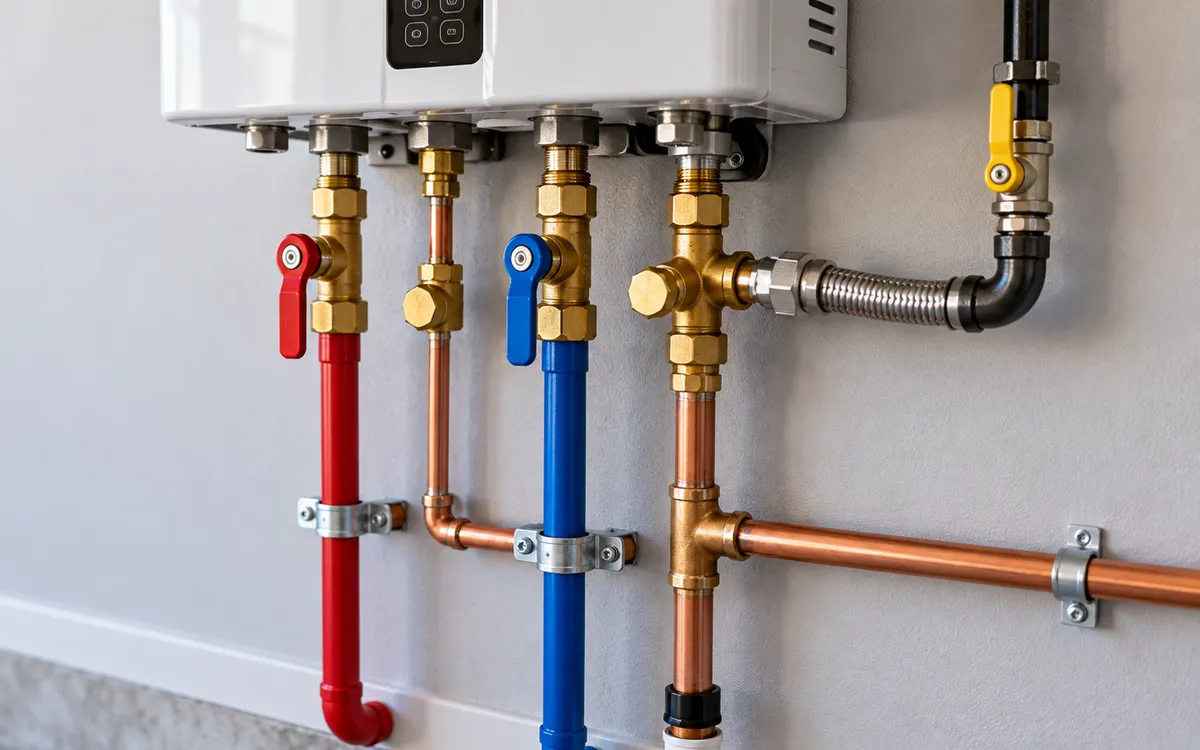 Isolation and gas valves below a tankless unit
Cause three: air, exhaust and water where it shouldn't be
Condensing tankless units exhaust through PVC or concentric pipe and produce acidic condensate that must drain. Both paths clog. Wasps and dirt daubers love Central Texas vent terminations; leaves and lint collect in intakes; a vent run with a low spot fills with condensate and chokes airflow. On the water side, the condensate trap gums up, the pressure relief valve starts weeping from thermal expansion, and isolation valves that were never exercised seize or drip.
Cause four: electronics and calibration
The control board is the unit's brain and, after a lightning storm or a utility surge, sometimes its first casualty. Thermistors drift with age and report temperatures that don't exist. Gas valves that were set for a different altitude or fuel deliver the wrong flame. None of these are visible from outside the case, which is why a proper diagnosis involves a multimeter and a manometer, not just a glance at the display. Sensor testing, board replacement and gas valve calibration each have their own page.
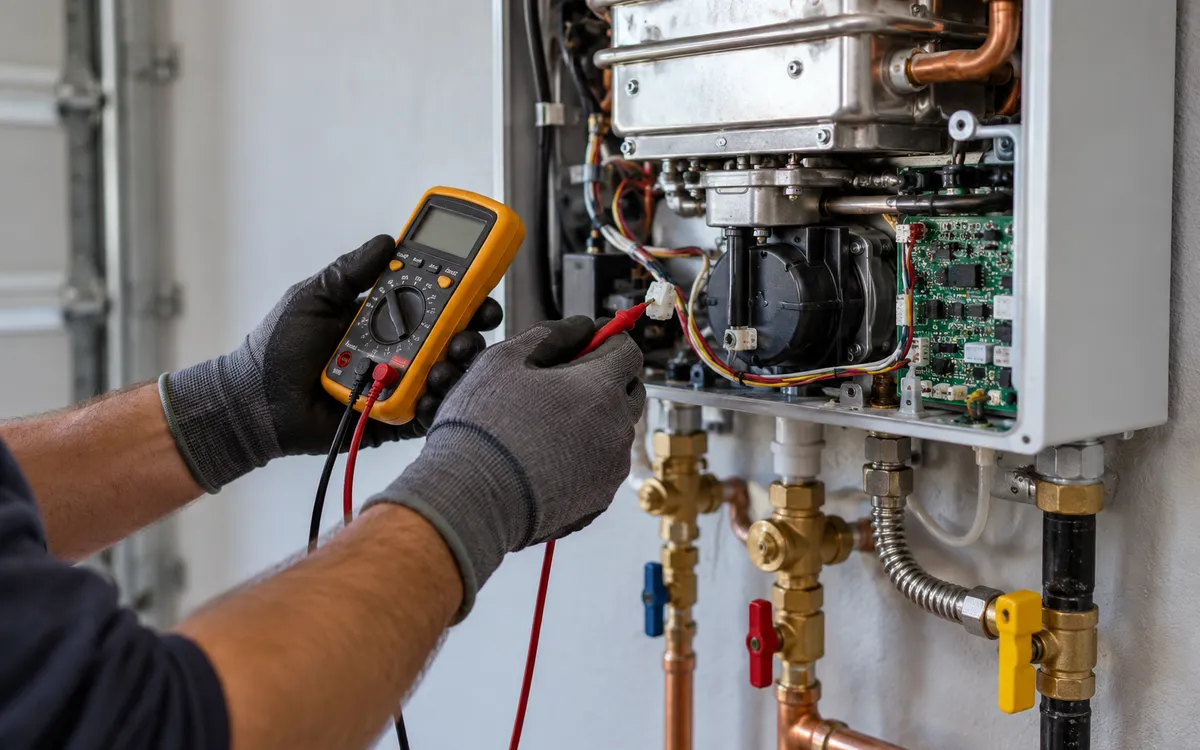 Measured first: sensors, flame signal, gas pressure
How a professional actually finds the fault
A good tankless technician starts with the code history stored in the unit, not just the code on the screen, because the first fault often triggers a cascade. They check inlet and outlet water temperatures against what the display claims. They pull the flame rod and electrode, inspect for soot or corrosion, and measure flame signal in microamps. They clock the gas meter or read manifold pressure with a manometer to confirm the unit is getting the fuel it was designed for. They look up the vent from the termination end and check the condensate path. Only then do they replace a part, which is why a diagnosis-first visit usually costs less overall than a parts-cannon approach.
What happens after the repair
Expect the plumber to run the unit through a full cycle at more than one fixture, confirm the outlet temperature matches the set point, and clear the error history so a stale code doesn't confuse the next visit. If scale was part of the picture, they'll recommend a flush interval and, in most Kyle homes, some form of scale protection. If the exchanger is compromised on a unit past its warranty, they'll give you an honest repair-versus-replace comparison; the heat exchanger page explains how that math works.
Pro tip Photograph the display the moment a code appears and again if it changes. Codes cycle, and the first one is usually the one that matters.
How it works
From cold shower to hot water in four steps
No forms, no callbacks in three days. One call, one referred plumber, one visit.
Call the number
Tell us the brand, what the unit is doing and any code you see. If you don't know, that's fine; "no hot water" is enough to start.
Get connected
We route your call to a licensed, insured Kyle-area plumbing company that services tankless heaters. You speak with them directly and book the visit.
Diagnosis first
The technician tests before replacing. You get a clear explanation of the fault and a quote for the fix before any work begins.
Repair and verify
Parts are replaced, the unit is cycled at multiple fixtures, and the error history is cleared. Most single-part repairs finish the same visit.
The cost of waiting
Small faults get expensive on a schedule
A tankless heater running with a minor fault rarely fails gracefully. A flame rod that's marginal today makes the unit short-cycle, and each aborted ignition stresses the electrode, the gas valve and the board. A light scale layer becomes a thick one, and a thick one cracks copper. A weeping relief valve becomes a puddle, and a puddle in a garage becomes ruined drywall and a mold remediation bill that dwarfs the repair.
There's also the efficiency cost you don't see. A scaled exchanger can push gas consumption up noticeably for the same hot water, so the fault you're ignoring shows up on the utility bill every month. And the last cost is timing: the unit that limps through October tends to quit on the first freezing night in January, when every plumber in Hays County is booked and same-day becomes next-week.
The rule is simple. If the unit is showing a code, making a new noise, or delivering water that's noticeably different than it was a month ago, that's the cheap moment to call.
Pricing
What drives the cost of a tankless repair
We don't publish prices because the referred plumber sets them and every unit is different. These are the factors that move a quote up or down, so you can judge one when you get it.
| Factor | Lower cost | Higher cost |
|---|---|---|
| Type of fault | Cleaning, sensor swap, flame rod, igniter, valve reset | Control board, gas valve, heat exchanger |
| Parts availability | Common Rinnai / Navien / Rheem parts stocked on the truck | Discontinued models or brands with slow parts supply |
| Unit access | Garage or utility room at chest height | Attic, tight closet, exterior unit on a second-story wall |
| Scale condition | Isolation valves present, flushed within the last year | No service valves, never flushed, exchanger heavily scaled |
| Warranty status | Exchanger or parts under manufacturer warranty (labor still applies) | Out of warranty, or warranty voided by missed maintenance |
| Timing | Weekday daytime appointment | After-hours, weekend or freeze-event emergency |
| Extras found | None | Vent repair, gas line upsizing, adding isolation valves |
Two things make a quote fair regardless of the number: a diagnosis you can understand, and a written scope that lists the part being replaced. If either is missing, ask.
Where we refer
Tankless repair across Kyle's neighborhoods
Every Kyle subdivision has its own mix of home ages and water heater setups. Here's what tends to come up in each.
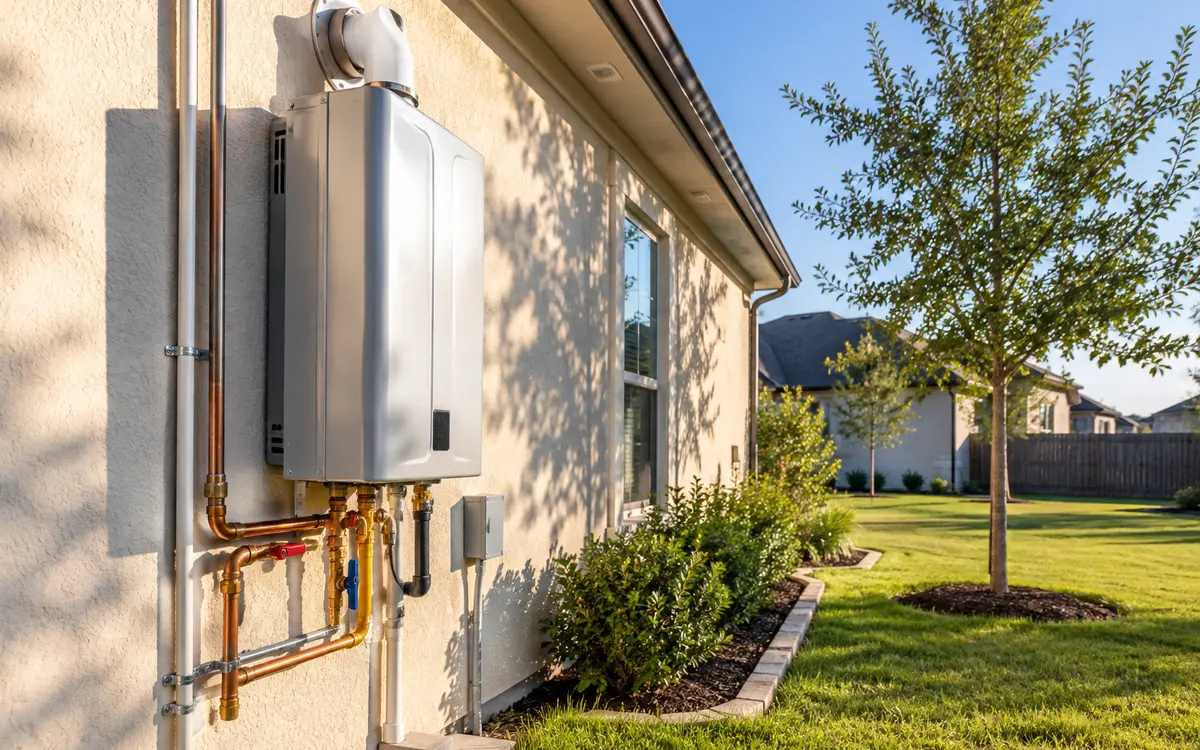 Garage and exterior installs are common across Kyle subdivisions
Amberwood
An established Kyle subdivision where many original tankless units are reaching the age when flame rods, igniters and scaled exchangers start producing intermittent codes. Repair-versus-replace conversations are common here.
Arroyo Ranch
Newer construction with builder-installed tankless units, often still under warranty. Calls here are usually first-time error codes, sizing questions and the first descaling service most owners haven't scheduled yet.
Brooks Crossing
Another newer Kyle community where units have run a few Central Texas summers without a flush. Temperature swings and early scale symptoms are the typical reason for the first service call.
Brookside
Family homes with multiple bathrooms running at once. Flow-rate complaints, the "cold water sandwich" and undersized units are the recurring themes, alongside routine scale maintenance.
Cool Springs
Mid-2000s homes where original equipment is near the end of its service life. Heat exchanger leaks and control board failures come up more here than in the newer subdivisions.
Cypress Forest
A starter-home neighborhood where budget matters. Owners here tend to want a clear repair-or-replace answer and the least expensive fix that will actually hold, which a diagnosis-first visit delivers.
Four Seasons Farm
Larger lots and larger homes mean longer pipe runs from the heater to the far bathroom. Recirculation problems and long waits for hot water are the calls we hear most from this area.
Indian Paintbrush
Newer builds with garage and exterior-wall units exposed to the weather. Freeze protection, post-freeze inspections and vent blockages from dirt daubers are the local specialties.
Kensington Trails
2010s homes where condensing tankless units are common. Condensate line clogs, spent neutralizers and vent slope issues account for a large share of service calls in this subdivision.
Meadow Woods
An established area where years of hard water have taken their toll. Descaling, heat exchanger assessment and softener or scale-shield integration are the services most often requested here.
Meadows of Kyle
A mixed-age neighborhood where some homes still run tank heaters and some have converted. Repairs on existing tankless units and questions about converting are both common calls.
Post Oak
An established east-side subdivision where gas valve and flame-sensing faults on older units show up regularly, along with the ignition lockouts that follow a few years of missed maintenance.
Steeplechase
Mid-2000s homes with original tankless installs. Error codes, aging sensors and full replacement of exhausted units are the typical reasons Steeplechase owners pick up the phone.
Waterleaf
Newer construction on Kyle's growing side of town, where tankless is standard. First-service flushes, warranty-era error codes and isolation valve retrofits are the everyday work here.
Referred plumbers also cover the areas just outside city limits, including Buda, Mountain City, Uhland, Niederwald and the north side of San Marcos. If you're near Kyle, call and ask.
Straight talk
How the referral works, and who actually shows up
Kyle Tankless Pros is a referral service. We are not a plumbing contractor, we don't employ technicians, and we don't perform repairs. What we do is maintain a relationship with a licensed, insured plumbing company that serves Kyle and the surrounding Hays County area and that actually works on tankless heaters rather than treating them as an afterthought. When you call, your call is connected to that provider. They handle scheduling, diagnosis, quoting, the repair and any warranty on the work, directly with you.
There is no fee to you for the referral. The provider may compensate us for the call, which is disclosed here and in our footer. It doesn't change what you pay them, and it doesn't obligate you to book. If the quote isn't right, you're free to walk away.
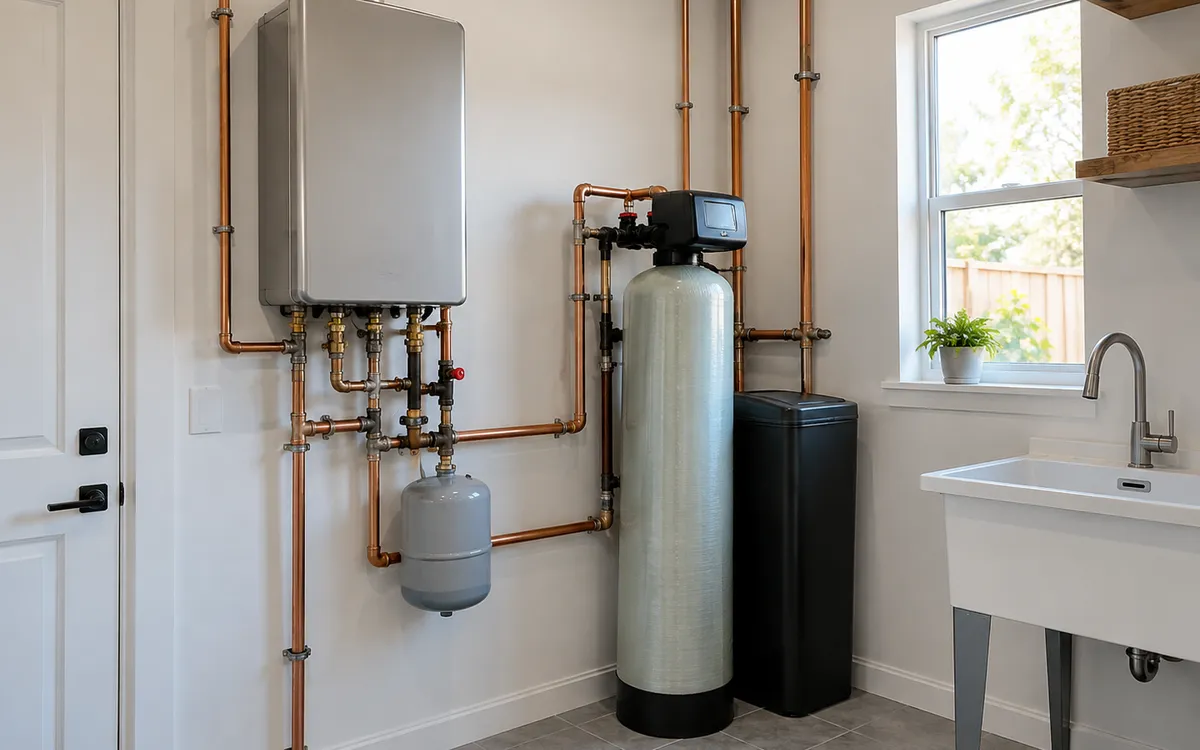 Independent licensed plumbers do the work
What we look for in a provider
- Current Texas plumbing license and liability insurance held by the provider company.
- Technicians who service the major tankless brands sold in Central Texas, with common parts stocked.
- A diagnosis-before-parts approach and written quotes before work begins.
- Workmanship warranty on repairs, provided and honored by the plumbing company.
- Reasonable same-day and next-day availability across Kyle.
Credentials belong to the provider, not to Kyle Tankless Pros. Ask the technician for license details at the visit; a reputable company will have them ready.
Before you call
Have these three things handy
None are required, but each one shortens the visit and improves the odds that the right part is on the truck.
- Brand and model. On a label on the side or bottom of the unit. A photo of the label is perfect.
- The error code, or a plain description: clicks and stops, hot-cold-hot, blank screen, leaking.
- Clear access. Move storage away from the unit and make sure the gas and water shut-offs are reachable.
Questions
Tankless repair questions Kyle homeowners ask
Why does my tankless water heater have no hot water?
The most common causes are an ignition or flame-sensing fault, a flow sensor that isn't detecting demand, a blocked vent, a gas supply problem, or a heat exchanger so scaled the unit locks out. The code on the display usually points to the family of faults, and a technician confirms the specific part with a test.
Can a tankless water heater be repaired, or does it need replacing?
Most faults are repairable. Sensors, flame rods, igniters, control boards, valves and vents are all replaceable. Replacement becomes the better choice when the heat exchanger has failed on an older unit, or when a repair quote approaches the cost of a new installation.
How often should a tankless water heater be flushed in Kyle?
Central Texas water is hard, so the annual flush most manufacturers recommend is the minimum here. Homes without a softener or scale inhibitor often benefit from a descaling every six to twelve months, and skipping it can void the exchanger warranty.
What does a Rinnai error code 11 or 12 mean?
Code 11 means the unit could not ignite. Code 12 means the flame lit but was then lost. Both point at gas supply, the igniter, the flame rod or venting, and both are normally repairable in one visit. The error code page covers Navien, Noritz and Rheem codes too.
Is the water heater making a loud noise dangerous?
Rumbling or kettling is usually scale on the heat exchanger. It's a maintenance issue, not an emergency. A loud bang, a whistling gas sound, or the smell of gas is different: shut the gas off if you can do so safely, leave the area, and call your gas utility from outside.
Do you repair Navien, Noritz and Rheem tankless units?
Yes. The plumbers we refer work on the major gas and electric tankless brands sold in Central Texas, including Rinnai, Navien, Noritz, Rheem, Bosch and A. O. Smith, and they carry common parts for the most popular models.
How does the referral work?
You call one number. We connect you with a licensed, insured local plumbing company that services tankless heaters in Kyle. They diagnose, quote and perform the work directly with you. Kyle Tankless Pros is a referral service, not the contractor. Details are in the how it works section above.
Is same-day tankless repair available in Kyle?
Same-day and next-day appointments are typically available, depending on the provider's schedule and the time of day you call. Calling in the morning gives the best chance of a same-day visit, and freeze events understandably stretch everyone's schedule.
What should I do before the plumber arrives?
Note the brand, model and any error code, clear access to the unit, and make sure the gas and water shut-offs are reachable. Don't remove the front cover; the wiring and gas connections inside are not a homeowner job.
What if the unit was damaged by a freeze?
Freeze damage usually shows up as a leaking heat exchanger or split fittings once the unit thaws. Shut off the water supply to the heater and call. A plumber can determine whether the exchanger itself or just the connected plumbing was affected, which makes a large difference to the repair.
Hot water today
Ready when your tankless heater isn't
One call connects you with a licensed Kyle plumber who repairs tankless units for a living. Same-day when available.
(737) 227-9987